
Compare
An AgentFire alternative for the solo agent
AgentFire is designed agent websites sold as a design package plus a monthly plan, with IDX built in. SiteCurb is a $39-a-month website you build yourself, with your own listings and your own address, live tonight. Here is the honest comparison — including who should stay put.
Updated October 2026
The verdict
Switch if you are a solo listing agent who wants a fast, good-looking site with your own listings on it, and $2,780 for the first year is more than you want to pay for it. Stay if your business runs on full-MLS IDX search or a built-in CRM — SiteCurb does not have either, on purpose. Not sure? Build a SiteCurb site free and decide when you see it: start your site.
AgentFire pricing: what year one costs
First-year total is the entry plan for twelve months plus setup and IDX fees where charged; the three-year total keeps the same plan for 36 months. AgentFire's higher tiers cost more; SiteCurb has one tier. Sources and dates are under the table.
| AgentFire | SiteCurb | |
|---|---|---|
| Monthly | $165/mo (Pro) or $215/mo (Plus) | $39/mo, flat |
| Setup fee | $800 Ignite, $2,750 Custom or $6,500 Firebrand design package | None |
| IDX / MLS feed | Included (MLS pass-through fees extra) | None — you add your own listings |
| First-year total | $2,780 | $468 |
| Three-year total | $6,740 | $1,404 |
| Contract | None — AgentFire says it does not do long-term contracts | None. Cancel anytime; billing stops. |
| How you buy | Published pricing; build takes 1.5 to 4+ weeks | Self-serve. Sign up, build free, pay only to publish. |
Sources: AgentFire pricing page (design packages, Pro $165/mo, no long-term contracts), read 6 September 2026. SiteCurb: $39 a month on the pricing page, nothing else to add.
That is 5.9× the cost for the year, and $5,336 more over three. Your first SiteCurb plan starts with a 14-day free trial, and you build the whole site before a card ever comes out: you pay only to publish.
Where AgentFire hurts a solo agent
AgentFire sells a design package up front — $800 for Ignite (four themes), $2,750 for Custom, $6,500 for Firebrand — then $165 a month for its Pro plan or $215 for Plus, with IDX included. It suits agents who want a designed site built for them and will wait 1.5 to 4+ weeks to get it.
- $800 leaves your account before the build starts, and $165 a month follows. A solo agent's first year on the cheapest package is $2,780 — almost six times SiteCurb.
- Semi-custom means someone builds it for you, which means waiting for it. SiteCurb is a self-serve editor: claim your address, pick a template, publish tonight.
- Go-live is "1.5 to 4+ weeks depending on your design package", in AgentFire's own words. SiteCurb's templates are server-rendered and publish the same day.
- Setup fees are the industry's way of charging you for the site you have not seen yet. SiteCurb has none; you build the whole thing free and pay only to publish.
What you give up with SiteCurb
The honest list. None of these is hidden in a footnote, so you can decide with them in view.
- No IDX or MLS feed. SiteCurb shows your listings — you add them yourself, with your photos (auto-optimized) and your words. That is what makes the $39 possible: there is nothing to license, so there is nothing to mark up. If your site needs to search the entire MLS, this is the wrong product.
- No CRM. SiteCurb isn't one, so there are no pipelines, drips or lead scoring. Every inquiry emails you the moment it's sent and lands in your dashboard. Sending inquiries to Notion works today, and connections that send them into Pipedrive, Zoho CRM and ActiveCampaign are rolling out.
- No custom domain yet. Your site lives at yourname.sitecurb.com, with a TLS certificate, the moment you publish. Connecting a domain you already own is in testing now.
Eleven templates, each with a live demo; your listings with photo galleries, your-voice fields (tagline, why work with me, client quotes), a draft preview before you publish, fast server-rendered pages with photos optimized as you upload them, and a broker-disclosure footer on every template. The SiteCurb app for Canva (in Canva's review now) publishes a listing photo or headshot straight to your site. No contract; cancel anytime and billing stops.
What SiteCurb does instead of IDX
SiteCurb doesn't do IDX, and it isn't pretending to. Here is what a SiteCurb site does in its place, and who that suits.
- Your listings, shown your way. You add each listing yourself, with your photos (optimized as you upload them), your price and your words, and each one gets its own page with a photo gallery.
- Every inquiry reaches you. The contact form and every listing's inquiry form email you the moment someone writes, with reply-to set so you answer from your own inbox, and the inquiry lands in your dashboard too.
- Buyers who want your next listing. A “get new listings first” block collects the people who want to hear when you list something new.
Right for listing agents and agents whose business comes from referrals and their sphere: a fast, good-looking site that shows your own listings and gets you the message. Get IDX instead if buyers searching the whole MLS on your site is how you find clients: then AgentFire or another IDX product is the right tool. More on that choice in IDX explained: does your website need it?
See a SiteCurb site before you decide
Every template runs as a live demo you can open on your phone right now. These two are built for big listing photography:
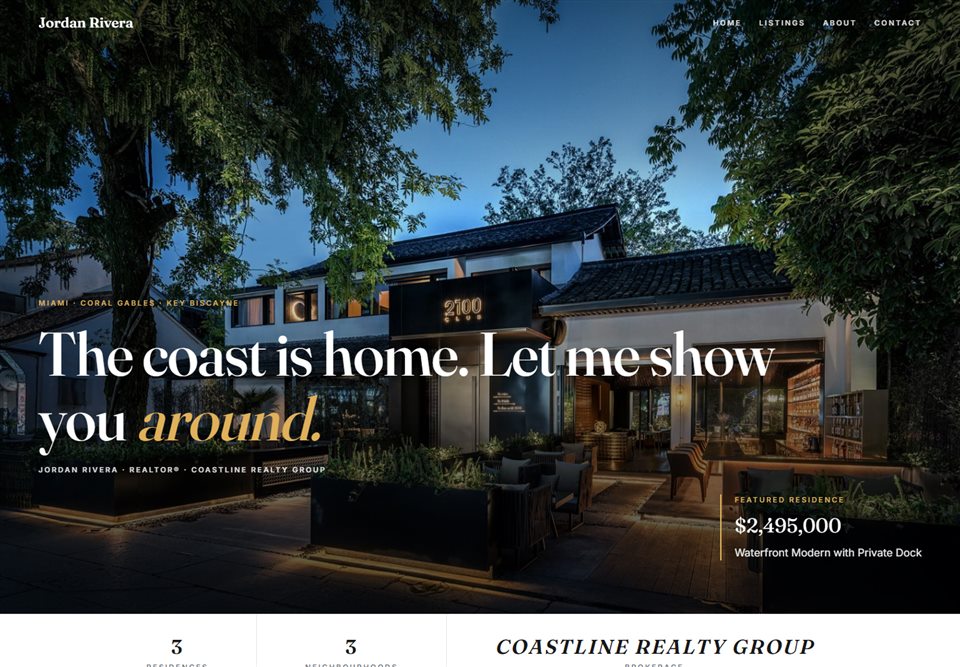
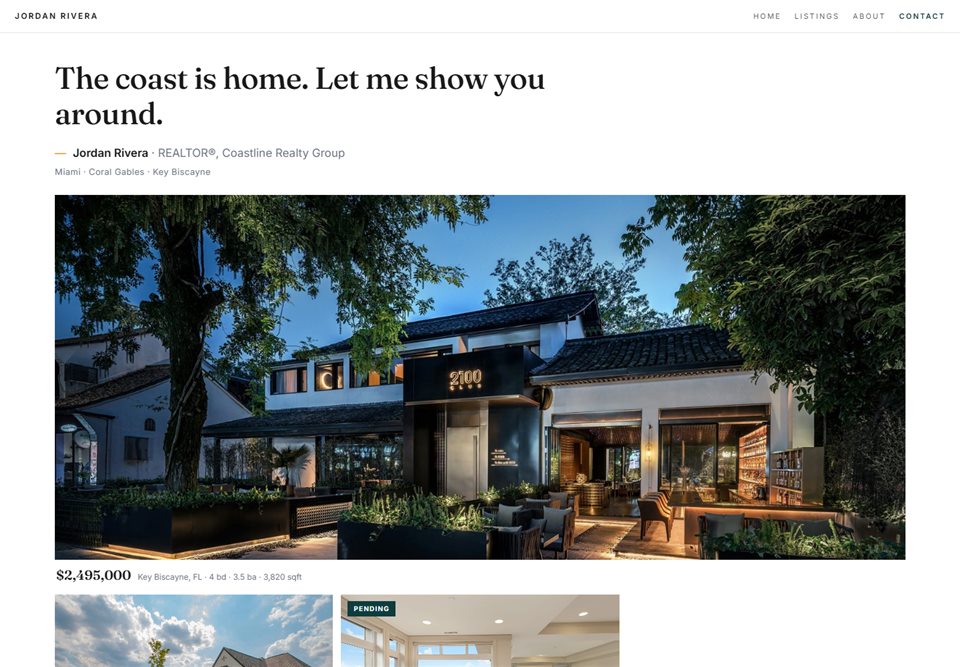
All eleven are on the examples page. The fastest proof is your own: build your site free, preview it, and only pay if you publish it.
Who should stay with AgentFire
Fair is fair. AgentFire is the better choice if:
- You want a designed site built for you, with custom interior pages and a designer on the job, and the package price is fine.
- You need IDX search on a designed site and would rather pay for the build than do it yourself.
Switching in an afternoon
- Claim your address. Sign up at SiteCurb and type your name — yourname.sitecurb.com is reserved on the spot. No card required to build.
- Pick a template. Open the live demos on the examples page, choose one, set your colors and logo. You can switch later; your content moves with you.
- Add your listings and your voice. Re-enter your active listings with your own photos, then fill in your tagline, why work with me, and a few client quotes.
- Preview, then publish. Check the draft, flip it live. The 14-day free trial starts here; after that it is $39 a month.
- Move your links and close the old account. Update your sign riders, cards, email signature and Instagram. Then cancel AgentFire when your current term allows — check your agreement for notice terms before you do.
Questions people ask
How much does AgentFire cost in the first year?
As of September 2026, per AgentFire's published pricing: an $800 Ignite design package (Custom is $2,750, Firebrand $6,500), then $165 a month on the Pro plan, with IDX included but MLS pass-through fees extra. A solo agent's first year on Ignite plus Pro is $2,780. SiteCurb is $468, with no setup fee and no IDX line.
Is an AgentFire site better for SEO than SiteCurb?
Not by itself. Google rewards fast pages with clear content, and SiteCurb's templates are server-rendered with no page-builder weight and photos optimized when you upload them. What matters more than the platform is your listings, your service areas and your words — all of which you write yourself on SiteCurb.
Can I customize a SiteCurb site the way AgentFire customizes theirs?
Within the template, yes: eleven layouts, your colors and logo, your photos, and your-voice fields for a tagline, why work with me, and client quotes. You cannot install plugins or edit code. If you need custom interior pages and a designer, AgentFire's Custom package is the better fit.
How long does switching from AgentFire take?
An afternoon. Sign up, claim yourname.sitecurb.com, pick a template, re-enter your active listings with your photos, and publish. Cancel AgentFire when your current term ends — check the order for notice terms.